Information economics studies how information and knowledge shape decisions, markets, contracts and forms of productive organisation. In the digital economy, information stops being an auxiliary resource and becomes an economic asset, a productive input and a source of power.
Information economics studies how data and knowledge influence decisions, markets, contracts and forms of productive organisation. Its starting point is simple: economic agents rarely have the same information, at the same time and of the same quality. That difference affects prices, negotiations, expectations and the distribution of power among consumers, firms and governments.
In the digital economy, information no longer occupies a merely auxiliary position. It has come to work as an economic asset, a productive input and a source of competitive advantage. Databases can improve services, reduce uncertainty and guide decisions, but their value depends on quality, organisation, usability and the rules that govern their collection and circulation.
For information systems professionals, this discussion has practical consequences, since the architecture of a piece of software defines which data will be collected, how they can be related and who will have access to them. The design of a platform influences the formation of markets, the visibility of participants, reputation mechanisms and the capacity for monetisation. Choices regarded as technical therefore also distribute opportunities, risks and responsibilities.
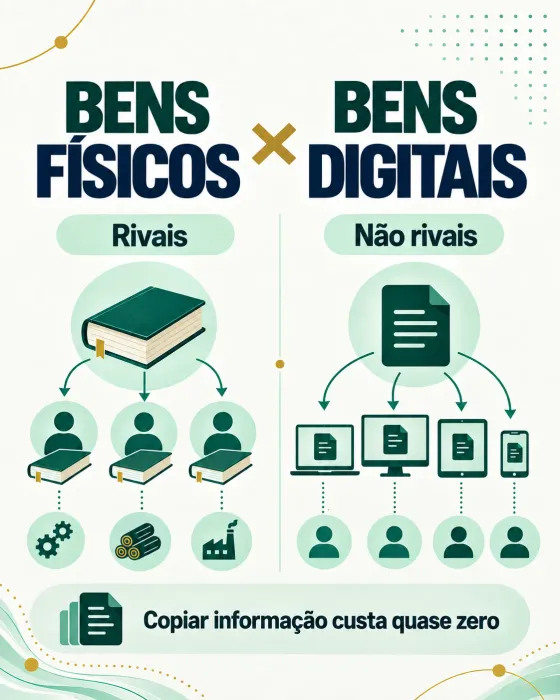
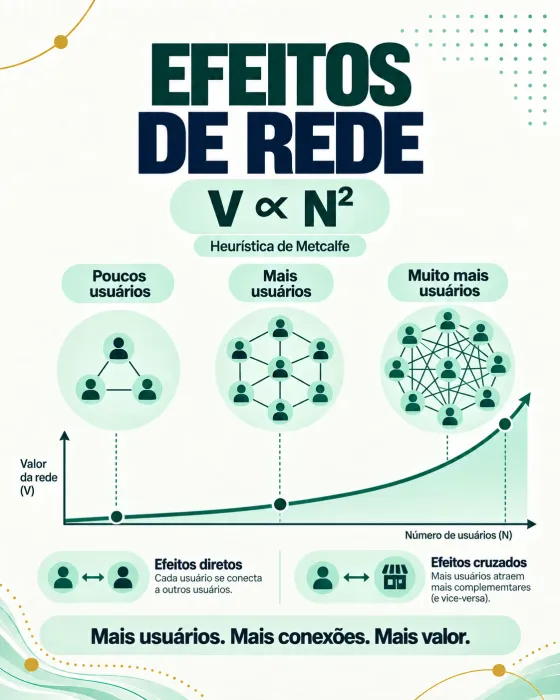
Over the course of this series I will examine how information asymmetries change decisions, why digital goods behave differently from physical goods and how network effects help platforms reach critical mass. I will also discuss multi-sided markets, versioning, bundling and freemium strategies, and the problems of concentration, digital power and regulation.
In sum, information economics offers instruments for understanding how data, knowledge and networks create value and reorganise economic relationships. This approach makes it possible to analyse digital systems more completely, considering at once their technological structure, their incentives and their effects on society.
Further reading
- Shapiro, C.; Varian, H. R. (1999). Information Rules: A Strategic Guide to the Network Economy. Boston: Harvard Business School Press. — The classic reference that organised the field for managers and engineers.
- Stiglitz, J. E. (2000). “The Contributions of the Economics of Information to Twentieth Century Economics”. Quarterly Journal of Economics, 115(4), 1441–1478. doi:10.1162/003355300555015
- Arrow, K. J. (1962). “Economic Welfare and the Allocation of Resources for Invention”. In: The Rate and Direction of Inventive Activity. Princeton: Princeton University Press / NBER, pp. 609–626. — The first treatment of information as an economically peculiar good.
- Goldfarb, A.; Tucker, C. (2019). “Digital Economics”. Journal of Economic Literature, 57(1), 3–43. doi:10.1257/jel.20171452 — A modern survey: the digital economy as a fall in the costs of search, replication, transport, tracking and verification.
- Brynjolfsson, E.; McAfee, A. (2014). The Second Machine Age. New York: W. W. Norton.
Websites to explore
- Cetic.br — Regional Center for Studies on the Development of the Information Society: the ICT Households, ICT Enterprises and ICT Electronic Government surveys, the main source of data on technology use in Brazil.
- UNCTAD — Digital Economy Report: periodic report on the digital economy in developing countries.
- OECD — Digital economy: indicators, policies and the Digital Economy Outlook.
- NBER — Economics of Digitization: recent working papers on the digital economy.