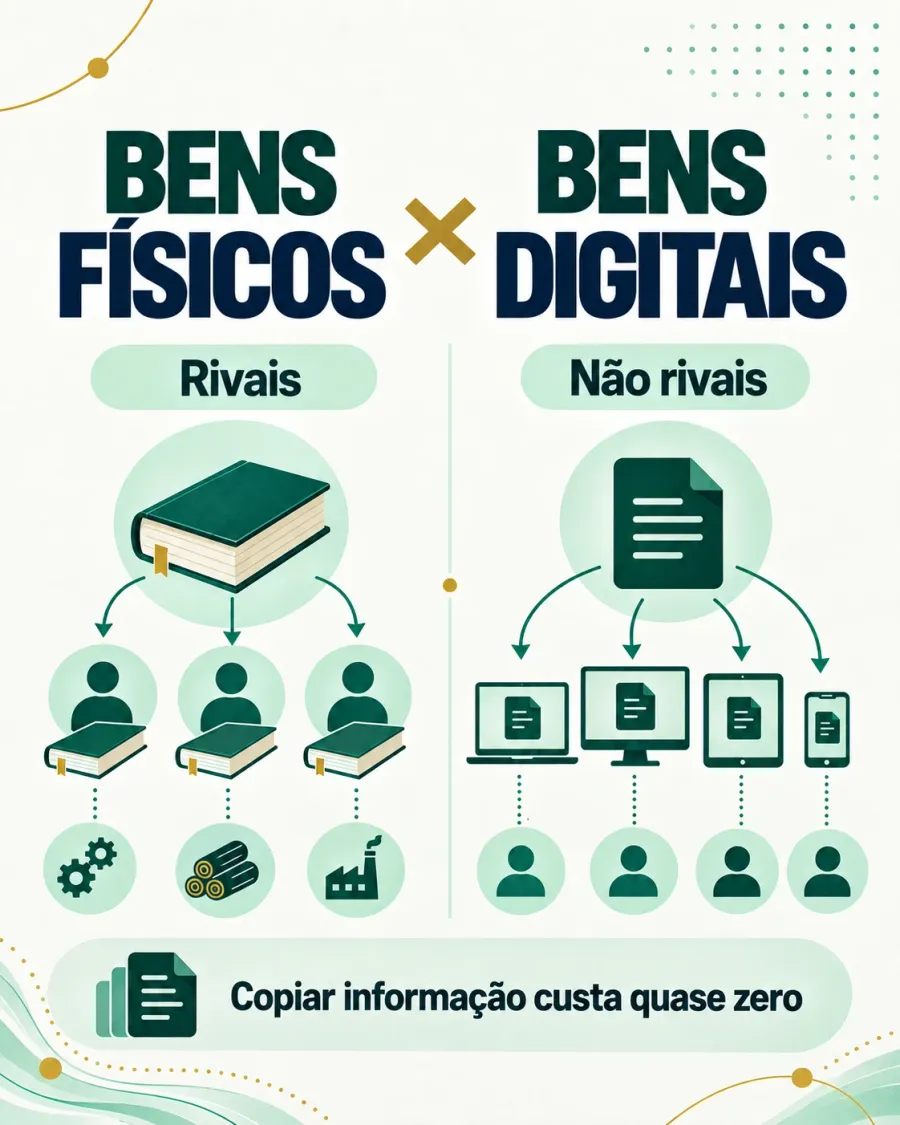
A physical good is rival; information and many digital goods are not. The initial production cost can be high, but an extra copy costs almost nothing, and that changes pricing and favours subscriptions, advertising, licensing, versioning, bundles and freemium.
A physical good is normally rival: when one person uses a given resource, it may no longer be available to someone else. Many digital goods behave differently. A piece of software, a file, a video or an e-book can be reproduced and used simultaneously by many people without the access of one of them reducing, in itself, the availability for the others.
This characteristic does not mean that producing information is cheap. Research, programming, infrastructure, editing and creative work can require substantial investment. The difference appears once the first version is ready, since the cost of making an additional copy available tends to be very low. The activity thus combines significant fixed costs with a marginal cost close to zero.
This structure limits the usefulness of pricing the product solely by the cost of producing one more unit. Firms come to consider the value perceived by different groups of users and turn to subscriptions, advertising, licensing, versioning, bundles and freemium models. The choice of revenue mechanism depends on the profile of demand, on operating costs and on the possibilities of controlling access.
Non-rivalry also turns exclusion into a decision built into the system’s architecture. Authentication, licences, digital rights management and usage restrictions define who can access the product and under which conditions. In the opposite direction, the same non-rivalry sustains free software, open data and Creative Commons licences, since sharing does not reduce the stock of information available.
In this way, the economic difference between physical and digital goods explains why information markets develop their own forms of pricing, access and distribution. For those who design systems, understanding this structure is essential to choosing coherent business models and access rules proportionate to the value and the rights involved.
Further reading
- Shapiro, C.; Varian, H. R. (1999). Information Rules. Boston: Harvard Business School Press. — Chapters 1 to 3: information goods, costs and pricing.
- Samuelson, P. A. (1954). “The Pure Theory of Public Expenditure”. Review of Economics and Statistics, 36(4), 387–389. doi:10.2307/1925895 — The origin of the distinction between rival and non-rival goods.
- Romer, P. M. (1990). “Endogenous Technological Change”. Journal of Political Economy, 98(5), S71–S102. doi:10.1086/261725 — Ideas as non-rival goods and economic growth.
- Goldfarb, A.; Tucker, C. (2019). “Digital Economics”. Journal of Economic Literature, 57(1), 3–43. doi:10.1257/jel.20171452
Websites to explore
- Creative Commons: licences that exploit non-rivalry to allow copying and reuse under clear rules.
- Open Source Initiative: the open-source definition and approved licences.
- Brazilian Civil Rights Framework for the Internet — Marco Civil (Law 12,965/2014): principles for internet use in Brazil, including net neutrality and liability for content.