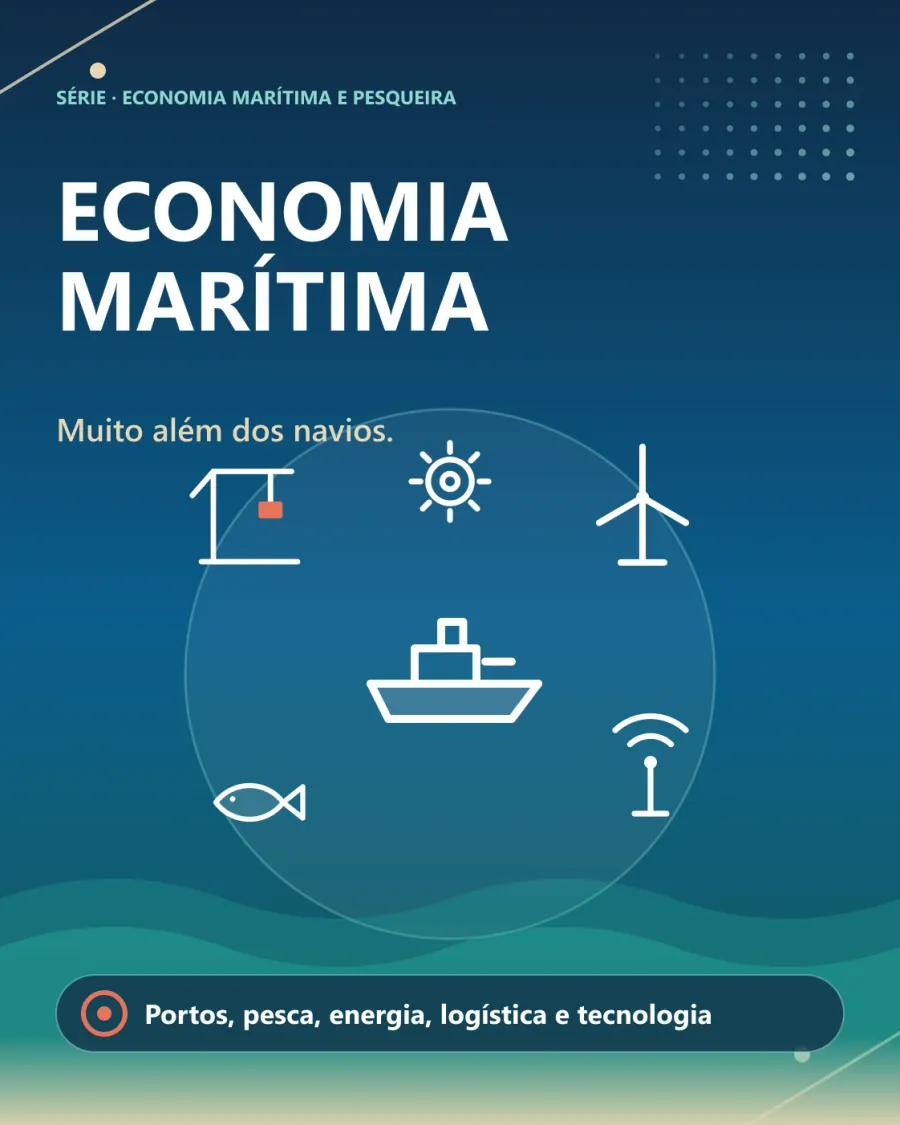
Maritime economics covers, beyond transport, port infrastructure, shipbuilding, logistics, fishing and aquaculture, offshore energy, technology and coastal services: activities that affect jobs, prices, exports, food security and regional development.
Maritime economics covers a broad set of activities associated with the sea and coastal zones. Beyond transport, it includes port infrastructure, shipbuilding and ship repair, logistics, fishing, aquaculture, offshore energy, technology, monitoring and coastal services. The performance of this set affects jobs, prices, exports, food security and regional development.
Measurement is a major difficulty. Many activities do not appear in national accounts under a single category called the “maritime sector”. They are spread across transport, industry, energy, services and food production. Building integrated indicators is therefore a condition for identifying the economic contribution of the sea, comparing territories and planning investment.
In Brazil, the expression Blue Amazon designates the extensive maritime area under national jurisdiction, estimated at about 5.7 million square kilometres. The Sectoral Plan for Marine Resources, coordinated by the Interministerial Commission for Marine Resources, organises public action related to the knowledge and use of those resources. These instruments show that the maritime agenda involves economic planning, science, defence, environmental protection and institutional coordination.
For Alagoas and Brazil’s Northeast, the subject brings together small-scale fishing, coastal tourism, ports, estuaries and the mouth of the São Francisco river. Each activity has its own needs, but all depend on the quality of infrastructure, of the environment and of the information available to guide public and private decisions.
In this way, maritime economics makes it possible to see how a single space articulates sectors that are usually analysed separately. Measuring these connections is the first step towards policies capable of generating income and competitiveness without compromising ecosystems and coastal communities.
Further reading
- Stopford, M. (2009). Maritime Economics. 3rd ed. London: Routledge.
- OECD (2016). The Ocean Economy in 2030. Paris: OECD Publishing. doi:10.1787/9789264251724-en
- Kildow, J. T.; McIlgorm, A. (2010). “The importance of estimating the contribution of the oceans to national economies”. Marine Policy, 34(3), 367–374. doi:10.1016/j.marpol.2009.08.006
- Colgan, C. S. (2013). “The ocean economy of the United States: Measurement, distribution, & trends”. Ocean & Coastal Management, 71, 334–343. doi:10.1016/j.ocecoaman.2012.08.018
- Notteboom, T.; Pallis, A.; Rodrigue, J.-P. (2022). Port Economics, Management and Policy. New York: Routledge. — Online version for educational use at porteconomicsmanagement.org.
Websites to explore
- Brazilian Navy — Blue Amazon and blue economy.
- Interministerial Commission for Marine Resources (CIRM): coordination of the PSRM and of marine-resource programmes.
- NOAA — Economics: National Ocean Watch (ENOW): an example of a system that measures the ocean economy by sector and county in the United States.
- European Commission — EU Blue Economy Report: the annual report on the European blue economy.