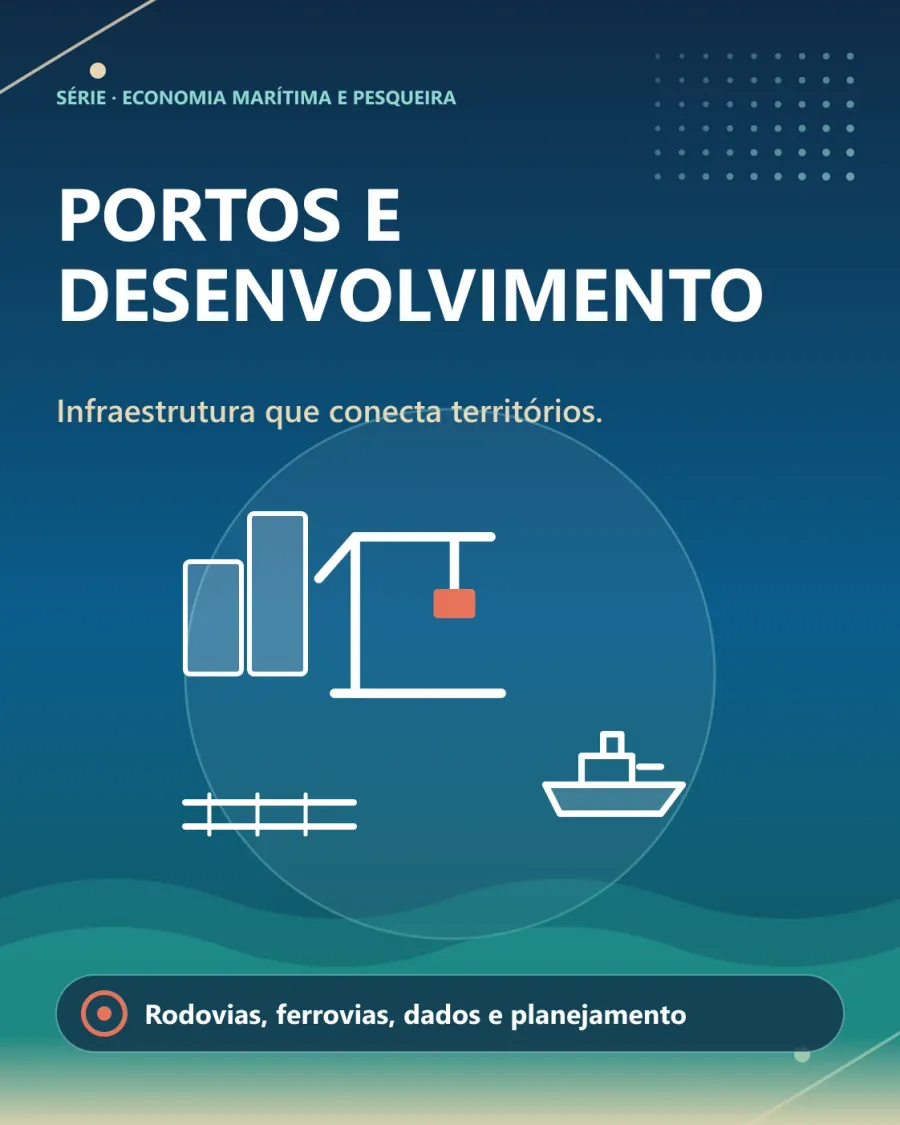
An efficient port cuts costs, eases exports, attracts investment and stimulates logistics and industry. But its impact on the territory depends on integration with roads, railways, information systems, urban planning and environmental policy, and on the externalities it creates.
Ports connect local economies to national and international markets. An efficient terminal can reduce costs, ease exports, attract investment and stimulate logistics and industrial activity. These benefits, however, depend on the relationship between the port and the territory and the networks that move people, goods and information.
Port efficiency has to be demonstrated by indicators. Waiting time to berth, vessel time in port, moves per hour and cost per container make it possible to compare operations and locate bottlenecks. Brazil has public data that can support this diagnosis and guide decisions on capacity, management and investment.
A port does not produce regional development automatically, since its effects depend on the hinterland, on road and rail access, on the presence of industries and services and on the capacity to integrate local firms into the chains it handles. An isolated port can move large volumes without producing proportionate change in its surroundings.
Digitalisation also influences performance. Single windows, port community systems and the integration of databases reduce rework, release times and transaction costs. At the same time, planning has to consider pollution, congestion, real-estate pressure and conflicts over the use of the territory, since these externalities fall on nearby cities and communities.
Therefore, ports contribute to development when operational efficiency, land connectivity, productive integration and the management of externalities advance together. Assessing these dimensions avoids confusing the volume handled with the benefit actually absorbed by the territory.
Further reading
- Notteboom, T.; Pallis, A.; Rodrigue, J.-P. (2022). Port Economics, Management and Policy. New York: Routledge. — Online version for educational use at porteconomicsmanagement.org.
- Bottasso, A.; Conti, M.; Ferrari, C.; Tei, A. (2014). “Ports and regional development: A spatial analysis on a panel of European regions”. Transportation Research Part A, 65, 44–55. doi:10.1016/j.tra.2014.04.006
- Ducruet, C. (ed.) (2015). Maritime Networks: Spatial Structures and Time Dynamics. London: Routledge.
- World Bank; S&P Global Market Intelligence (2024). The Container Port Performance Index 2023. Washington, DC: World Bank. Publication
- Brazilian Ports Law (Law 12,815/2013): full text.
Websites to explore
- ANTAQ — Brazil’s National Waterway Transport Agency: its Waterway Statistics panel gives cargo throughput by port, navigation type and commodity in monthly series; Base dos Dados mirrors the yearbook in open format.
- Brazilian Ministry of Ports and Airports: sector planning and concessions.
- Port Economics, Management and Policy: the online version of the textbook by Notteboom, Pallis and Rodrigue.