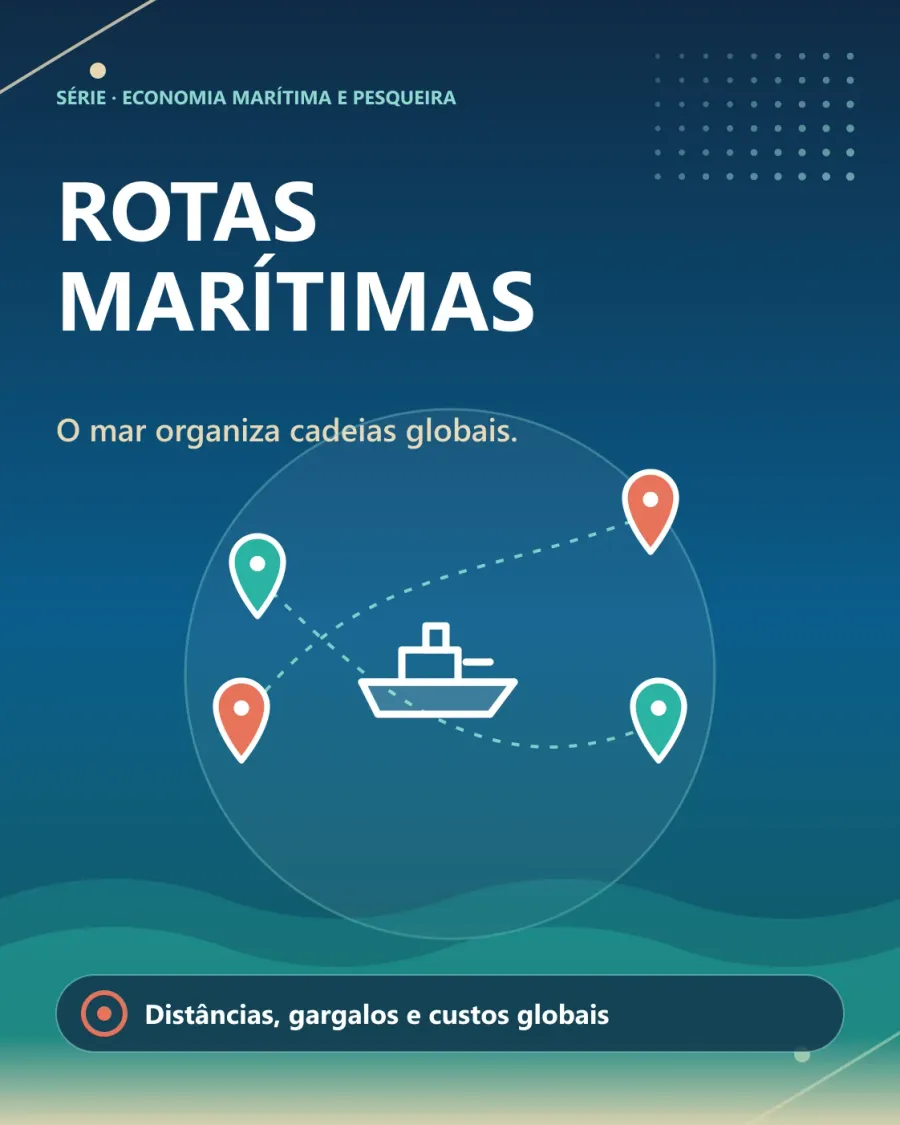
Most international trade depends on shipping. Distances, port capacity, fuel, voyage time, insurance and bottlenecks shape the final price of goods, and a disruption at a strategic passage affects supply chains in many countries.
A large share of international trade depends on maritime transport. Distance, port capacity, fuel prices, voyage time, insurance and the availability of vessels influence the final cost of goods. Shipping routes are therefore part of the world’s economic infrastructure and affect firms and consumers far beyond coastal regions.
Canals and straits concentrate large flows in relatively narrow passages. Suez, Panama, Malacca, Hormuz and Bab el-Mandeb are examples of chokepoints. When one of these passages closes, loses capacity or becomes unsafe, vessels may be diverted to longer routes, with higher freight rates and longer lead times.
The cost of transport is not only the amount paid for freight. It also includes insurance, the risk of delay, capital tied up during the voyage and the need to hold larger inventories to offset uncertainty. A localised disruption can thus produce successive effects on factories, distribution centres, exporters and consumer prices.
For countries geographically distant from the main markets, such as Brazil, these costs work as a kind of natural tariff on exports and imports. Port efficiency, logistical predictability and integration with land networks become decisive factors for competitiveness.
In short, shipping routes organise global supply chains and transmit shocks between countries. Understanding their costs and vulnerabilities helps governments and firms plan infrastructure, inventories and logistical alternatives capable of reducing the effects of disruptions.
Further reading
- UNCTAD (2024). Review of Maritime Transport 2024. Geneva: United Nations. Report — Includes the analysis of recent disruptions in the Red Sea and the Panama Canal.
- Rodrigue, J.-P. (2024). The Geography of Transport Systems. 6th ed. New York: Routledge. — Open version at transportgeography.org.
- Hummels, D. (2007). “Transportation Costs and International Trade in the Second Era of Globalization”. Journal of Economic Perspectives, 21(3), 131–154. doi:10.1257/jep.21.3.131
- Limão, N.; Venables, A. J. (2001). “Infrastructure, Geographical Disadvantage, Transport Costs, and Trade”. World Bank Economic Review, 15(3), 451–479. doi:10.1093/wber/15.3.451
- Verschuur, J.; Koks, E. E.; Hall, J. W. (2022). “Ports’ criticality in international trade and global supply-chains”. Nature Communications, 13, 4351. doi:10.1038/s41467-022-32070-0
Websites to explore
- IMF PortWatch: near-real-time monitoring of traffic at ports and chokepoints from satellite (AIS) data.
- UNCTADstat — Maritime transport: series on fleets, connectivity and freight rates.
- The Geography of Transport Systems: open maps and chapters on routes, ports and corridors.