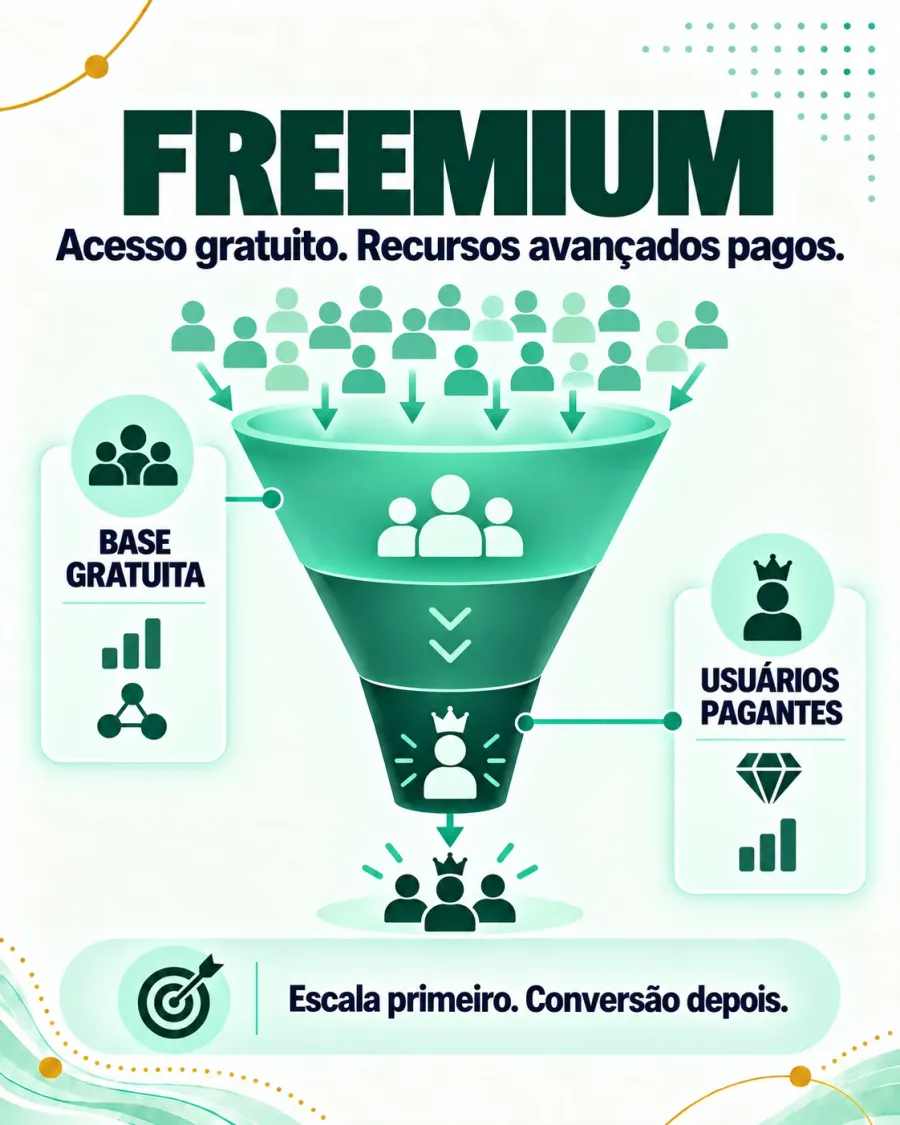
Freemium combines a free basic version with paid plans. The free version lowers the entry barrier and helps reach critical mass; sustainability depends on conversion, on the cost of the free base and on a clear difference in value between plans.
The freemium model combines a free basic version with paid plans that offer additional features. Free access lowers the entry barrier, widens the user base and can help a platform reach critical mass. Free access, however, is part of a segmentation strategy and needs to be sustained by revenue from subscriptions, advertising or other sources compatible with the service.
Spotify, Dropbox and Zoom illustrate different ways of organising the model. The free version may carry ads, limit storage, restrict the length of meetings or reduce the number of projects. Paid plans remove those limits or add features aimed at users with heavier usage and greater willingness to pay.
A zero price produces a pull that tends to be greater than the mere saving of a few cents. This characteristic favours experimentation and recommendation, especially in products that benefit from network effects. The strategy is viable when the marginal cost of serving each free user stays low and when the enlarged base contributes to acquisition, product learning or conversion.
Sustainability depends on the conversion rate, on the cost of the free base and on the difference in utility between plans. Since only a share of users usually takes up the paid version, overly generous limits can raise costs without producing revenue, while severe restrictions prevent users from recognising the product’s value. The design of the free plan therefore has to allow real use and, at the same time, offer legitimate reasons to upgrade.
In short, freemium works when free access widens the market without undermining the capacity to fund the service. The balance depends on controlled costs, transparent communication and a progression of value that respects the user instead of turning artificial limitations into pressure to buy.
Further reading
- Kumar, V. (2014). “Making ‘Freemium’ Work”. Harvard Business Review, May 2014. hbr.org
- Anderson, C. (2009). Free: The Future of a Radical Price. New York: Hyperion.
- Shampanier, K.; Mazar, N.; Ariely, D. (2007). “Zero as a Special Price: The True Value of Free Products”. Marketing Science, 26(6), 742–757. doi:10.1287/mksc.1060.0254
- Liu, C. Z.; Au, Y. A.; Choi, H. S. (2014). “Effects of Freemium Strategy in the Mobile App Market: An Empirical Study of Google Play”. Journal of Management Information Systems, 31(3), 326–354. doi:10.1080/07421222.2014.995564
- Shapiro, C.; Varian, H. R. (1999). Information Rules, chapter 4 (“Rights Management”) — the logic of giving away to sell.
Websites to explore
- Spotify Premium, Dropbox — plans and Zoom — plans: compare what stays in the free plan and where the limits kick in.
- Cetic.br — ICT Households: data on income and use of digital services in Brazil, relevant for estimating the free base.