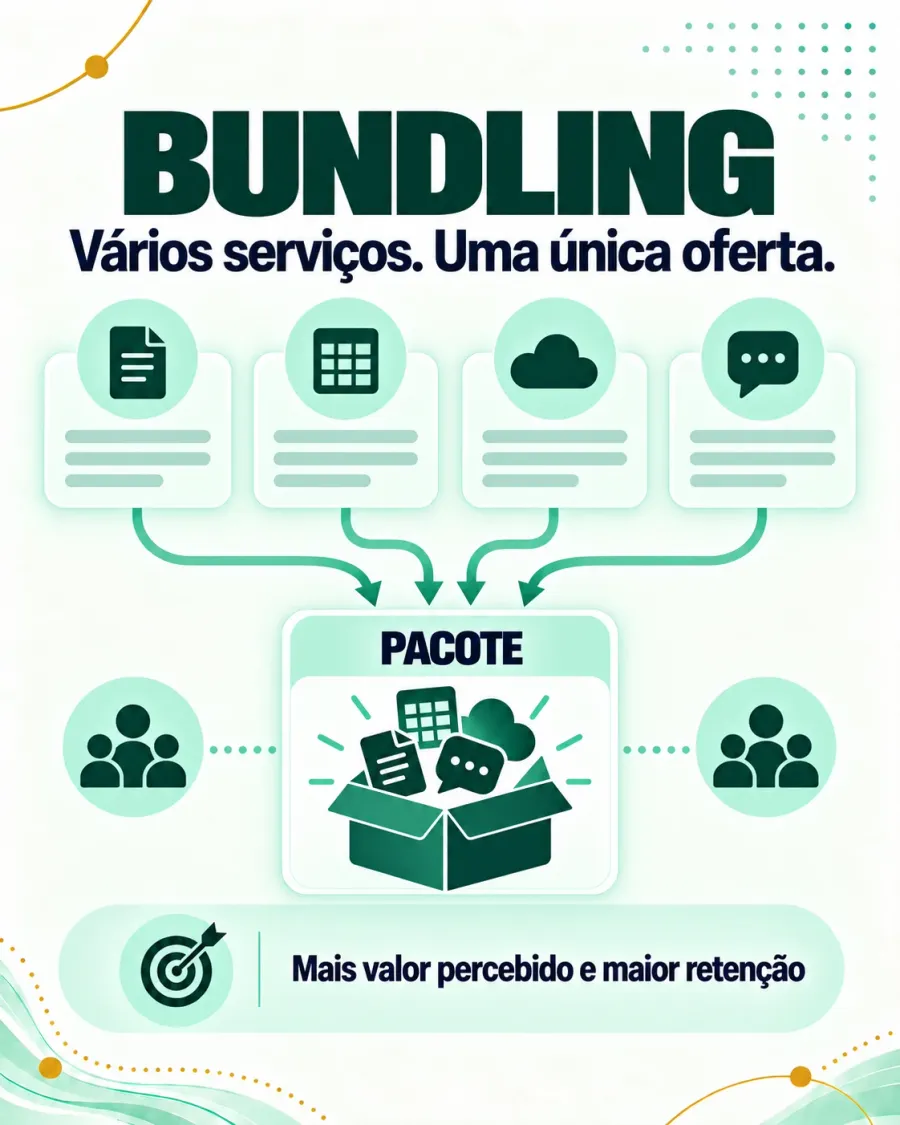
Bundling is the grouping of products or services into a single package that usually costs less than the components bought separately, raises perceived value, increases retention within the ecosystem and makes life harder for competitors that sell a single, stand-alone solution.
Educational and informational content. It is not legal advice, guidance for a specific case or an institutional position. Examples and analyses use only legitimate sources and public data, aggregated or properly anonymised.
Bundling is the joint offer of products or services in a single package. The price of the set is usually lower than the sum of the components bought separately, which raises the perceived value for consumers with different preferences. Common examples include Microsoft 365, streaming bundles, combinations of domain, hosting, e-mail and digital certificate, and ecosystems that bring together storage, productivity and communication.
The economic logic of the bundle is related to the diversity of willingness to pay. One user may value a word processor more, while another attaches greater utility to storage or communication. By combining the items, the firm reduces the dispersion of these valuations and manages to offer a single price acceptable to a larger share of the market.
The model is especially attractive for information goods, since including one more component may add little to the marginal cost. The bundle also favours the user’s permanence in the ecosystem, simplifies purchasing and integrates features. These advantages, however, do not eliminate its possible effects on competition.
A firm with an established position can use the bundle as an entry barrier. A competitor offering only a spreadsheet, a communication service or another specific solution comes to compete with a set in which the equivalent product seems to have no separate price. For that reason, bundling and tying frequently appear in competition analyses.
Thus, bundling can reduce transaction costs and offer convenience, but it can also reinforce closed ecosystems and limit competition from specialised suppliers. Evaluating it therefore requires considering price, the possibility of choice, effective integration and effects on the entry of competitors.
Further reading
- Adams, W. J.; Yellen, J. L. (1976). “Commodity Bundling and the Burden of Monopoly”. Quarterly Journal of Economics, 90(3), 475–498. doi:10.2307/1886045
- Bakos, Y.; Brynjolfsson, E. (1999). “Bundling Information Goods: Pricing, Profits, and Efficiency”. Management Science, 45(12), 1613–1630. doi:10.1287/mnsc.45.12.1613 — The central result for information goods.
- Bakos, Y.; Brynjolfsson, E. (2000). “Bundling and Competition on the Internet”. Marketing Science, 19(1), 63–82. doi:10.1287/mksc.19.1.63.15182
- Nalebuff, B. (2004). “Bundling as an Entry Barrier”. Quarterly Journal of Economics, 119(1), 159–187. doi:10.1162/003355304772839551
- Shapiro, C.; Varian, H. R. (1999). Information Rules, chapter 3 (“Versioning Information”) — includes the discussion of bundles.
Websites to explore
- European Commission — Competition policy: cases and decisions on tying in digital markets.
- CADE — Brazil’s Administrative Council for Economic Defense: Brazilian case law on tying and unilateral conduct.
- Microsoft 365 — compare plans: a practical reading of a bundle — what is in, what is out and for whom.