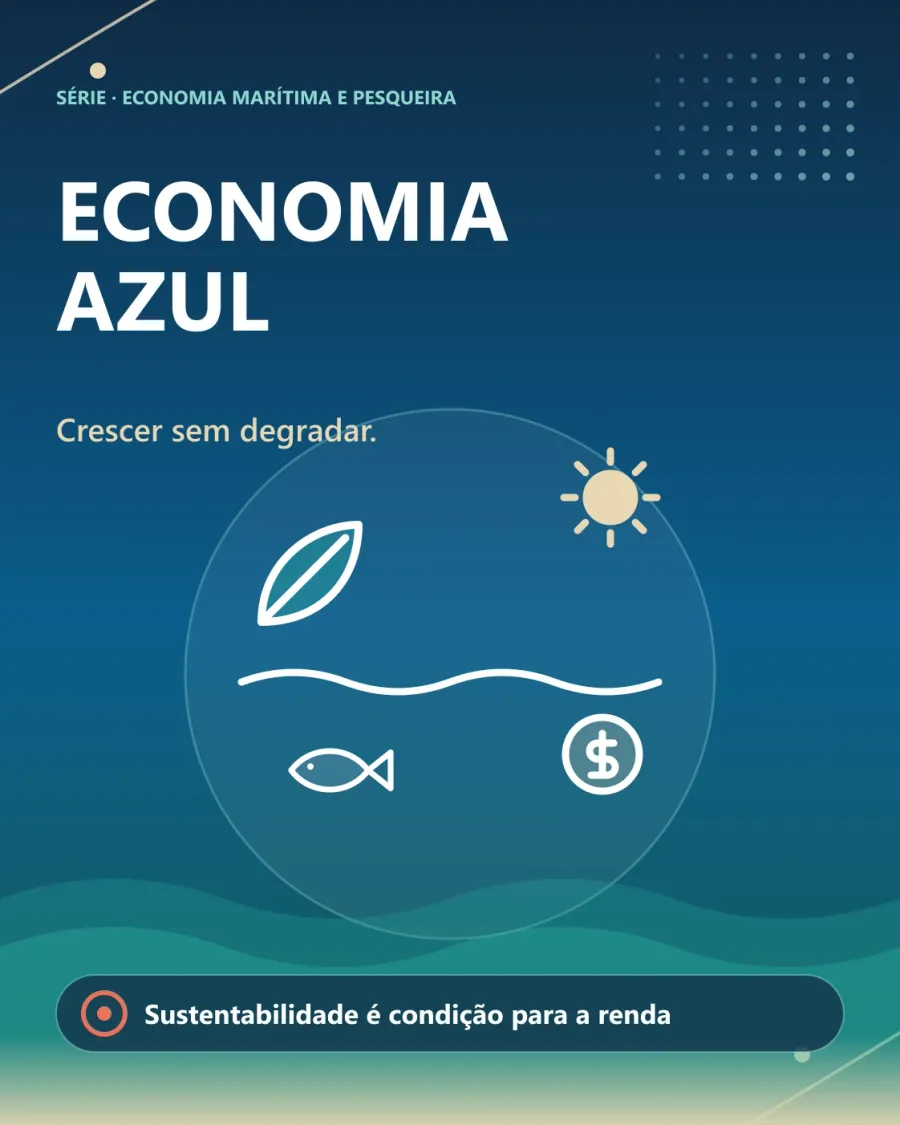
The blue economy seeks to reconcile sea-related economic activity with environmental conservation and community well-being. The value produced by the oceans depends on healthy ecosystems; sustainability is a condition for continued income, not a separate goal.
The blue economy seeks to reconcile sea-related economic activities with environmental conservation and the well-being of communities. Its foundation is both economic and ecological, since the income generated by fishing, tourism, shipping and other uses depends on maintaining ecosystems capable of providing services and renewing resources.
The degradation of mangroves, reefs, estuaries and fish stocks reduces productivity and increases the vulnerability of coastal populations. Mangroves and estuaries work as breeding and nursery grounds for species of commercial interest. Protecting them therefore preserves future productive capacity and should not be treated merely as an environmental cost.
The concept gained international prominence after the Rio+20 Conference and was incorporated into agendas such as Sustainable Development Goal 14, dedicated to life below water. Moving from concept to public policy requires targets, indicators and instruments capable of reconciling competing economic uses of marine space.
Marine protected areas, closed seasons and spatial planning are examples of such instruments. Their effectiveness depends on data, enforcement and the participation of those who live from the sea. Without monitoring of results and social legitimacy, formally adequate measures can displace problems or impose disproportionate costs on certain groups.
Thus, the blue economy treats sustainability as a condition for the continuity of sea-related income and work. Consistent policies therefore have to protect the ecological base, distribute costs and benefits fairly and assess whether the instruments adopted produce the expected results.
Further reading
- World Bank; United Nations Department of Economic and Social Affairs (2017). The Potential of the Blue Economy: Increasing Long-term Benefits of the Sustainable Use of Marine Resources for Small Island Developing States and Coastal Least Developed Countries. Washington, DC: World Bank. Publication
- OECD (2016). The Ocean Economy in 2030. Paris: OECD Publishing. doi:10.1787/9789264251724-en
- Bennett, N. J. et al. (2019). “Towards a sustainable and equitable blue economy”. Nature Sustainability, 2, 991–993. doi:10.1038/s41893-019-0404-1
- Costanza, R. et al. (2014). “Changes in the global value of ecosystem services”. Global Environmental Change, 26, 152–158. doi:10.1016/j.gloenvcha.2014.04.002
Websites to explore
- SDG 14 — Life Below Water (United Nations): targets and indicators for the conservation and sustainable use of the oceans.
- ICMBio — Chico Mendes Institute for Biodiversity Conservation: marine and coastal protected areas in Brazil.
- European Commission — Blue economy: policies and the annual blue economy report.
- Brazilian Navy — blue economy and Blue Amazon.