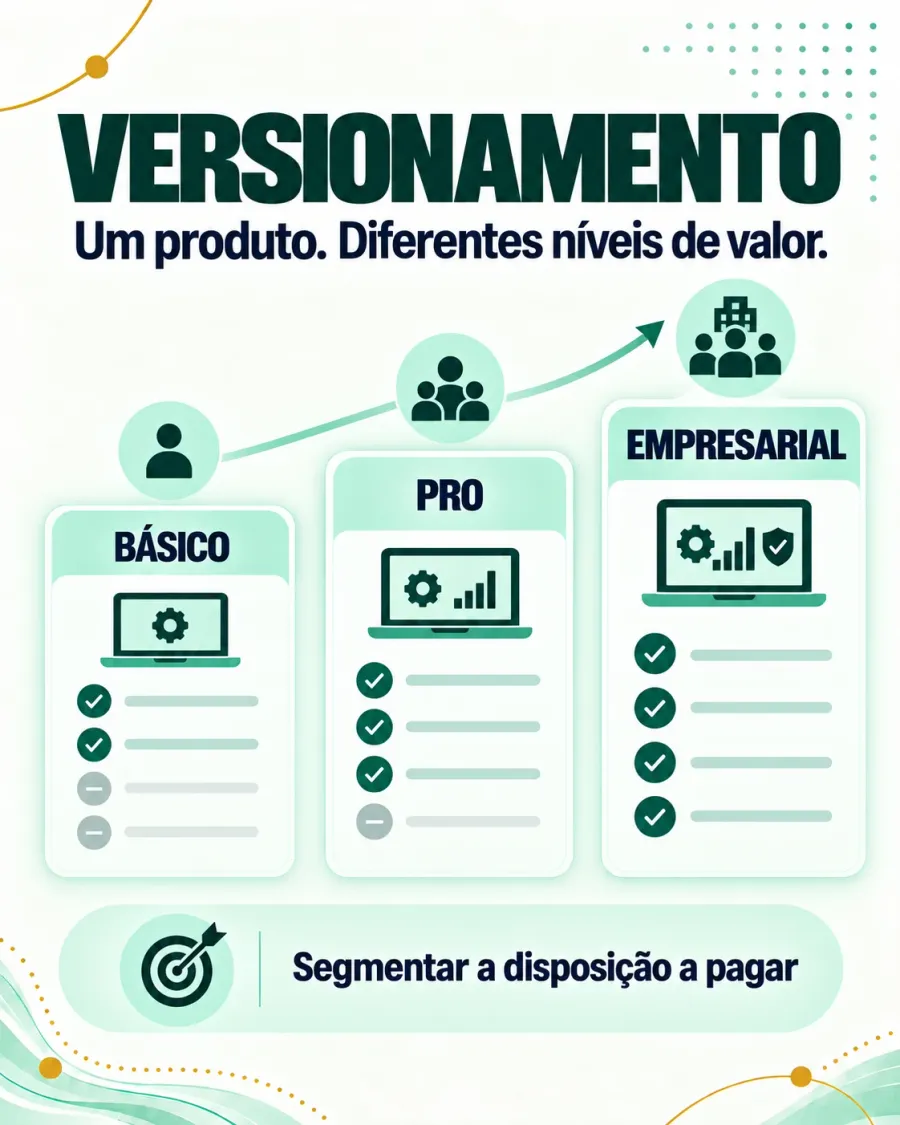
Versioning means offering different versions of the same product to audiences with different needs and willingness to pay, varying features, capacity, support, security or number of users, without developing separate products.
Versioning consists of offering different configurations of the same product to audiences with different needs and willingness to pay. Versions can vary in features, capacity, speed, support, security, number of users or integration options. The firm uses a common base and organises differentiated offers without having to develop entirely separate products.
This model appears in the individual, business and education plans of Adobe Creative Cloud, in LinkedIn’s tiers, in the Home and Pro editions of Windows and in the basic, professional and enterprise tiers of many software services. Each version seeks to match a usage profile and to present a difference in value that justifies the consumer’s choice.
In economic terms, versioning is a form of second-degree price discrimination. Since the firm does not directly know each customer’s willingness to pay, it offers a menu of options and lets users reveal their own profile through their choice. Versions need to be sufficiently distinct, since the migration of customers willing to pay more towards a lower offer can undermine the strategy.
In certain situations the cheaper version results from deliberately limiting a technically more complete product. The literature calls this phenomenon “damaged goods”, since the firm may incur costs to restrict features that already exist. The strategy protects the price of the premium version, but it requires attention to licence clauses, usage limits and duties to inform the consumer.
In summary, versioning turns differences between users into a structure of offers. When versions are clear, proportionate and transparent, the strategy widens access and improves the fit of the product. When limitations are artificial or hard to understand, on the other hand, it can generate frustration and legal challenges.
Further reading
- Shapiro, C.; Varian, H. R. (1998). “Versioning: The Smart Way to Sell Information”. Harvard Business Review, November–December 1998. hbr.org
- Varian, H. R. (1997). “Versioning Information Goods”. Working paper, University of California, Berkeley. — The theoretical basis of the strategy.
- Deneckere, R. J.; McAfee, R. P. (1996). “Damaged Goods”. Journal of Economics & Management Strategy, 5(2), 149–174. doi:10.1111/j.1430-9134.1996.00149.x — Why deliberately degrading a product can pay off.
- Bhargava, H. K.; Choudhary, V. (2008). “When Is Versioning Optimal for Information Goods?” Management Science, 54(5), 1029–1035. doi:10.1287/mnsc.1070.0773
- Varian, H. R. (1989). “Price Discrimination”. In: Handbook of Industrial Organization, vol. 1, pp. 597–654. — An overview of price discrimination.
Websites to explore
- LinkedIn Premium and Windows editions compared: pricing pages are a practical exercise in reading versioning — what changes between versions and what it costs.
- Brazilian Consumer Defence Code (Law 8,078/1990): clear information about what each version includes is a legal duty in Brazil.