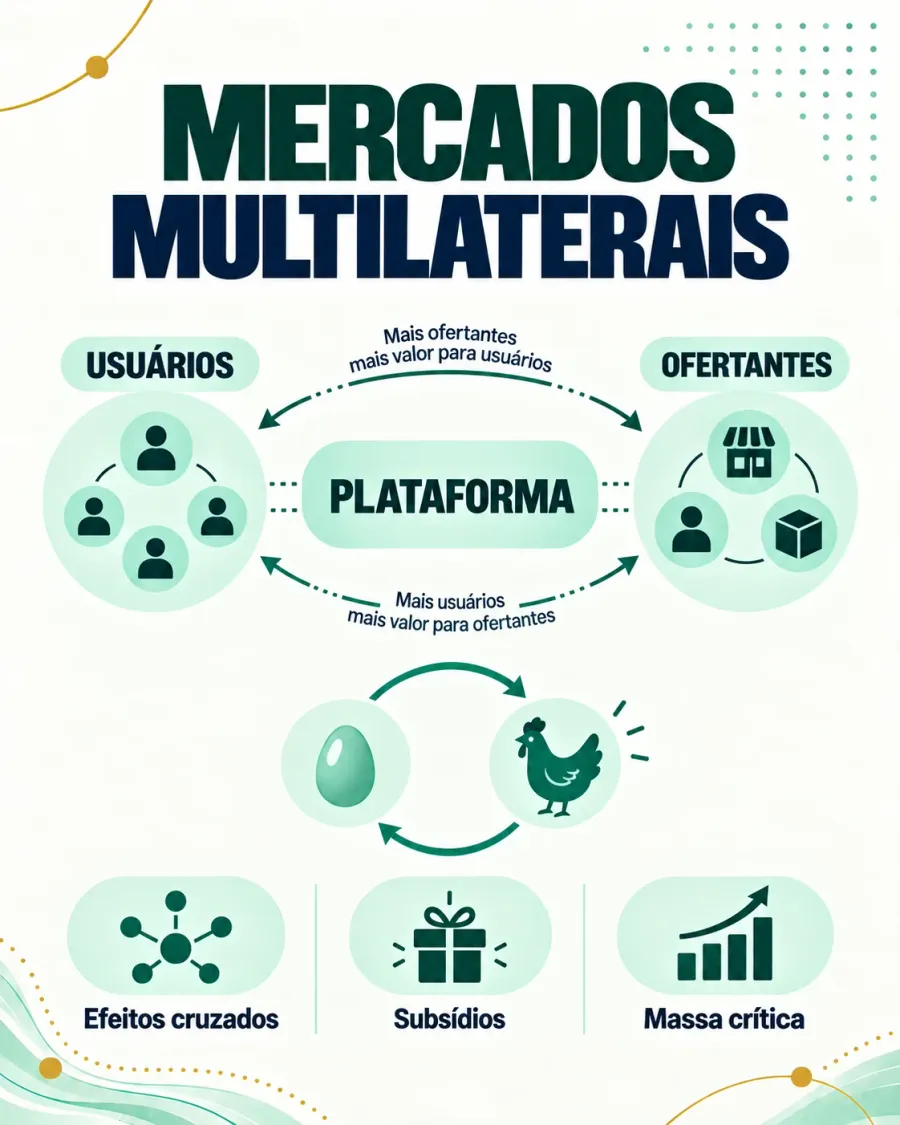
Multi-sided platforms bring together groups that need each other: consumers and sellers, passengers and drivers, developers and users. Each side's value depends on the other, which creates the chicken-and-egg problem and justifies cross-subsidies.
Educational and informational content. It is not legal advice, guidance for a specific case or an institutional position. Examples and analyses use only legitimate sources and public data, aggregated or properly anonymised.
Multi-sided platforms bring together groups that need one another, such as consumers and sellers, passengers and drivers, advertisers and audiences, developers and users. The service provided is not limited to technological infrastructure, since the platform also sets rules, organises matches, reduces search costs and manages trust mechanisms.
The value perceived by each group depends on the presence and participation of the others. This gives rise to the so-called chicken-and-egg problem: it is hard to attract buyers without sellers and sellers without buyers. To overcome that obstacle, the platform can subsidise, reward or charge less to the side that produces the largest positive externality for the whole. In some cases one group uses the service for free while another funds the operation.
Deciding who pays and who receives incentives is part of the economic design of the product. The platform also has to decide how to verify identities, control quality, organise ratings, moderate conduct and prevent participants from bypassing the service after the first contact. These choices affect safety, reputation, conversion and financial sustainability.
As the platform grows, it becomes just as important to examine how the value created is shared. Fees, access rules, data handling and ranking criteria can change the economic position of each side. The platform’s market power therefore shifts the balance between the efficiency of intermediation, the remuneration of participants and freedom of choice.
Therefore, the success of a multi-sided market depends on the articulation between technological architecture and the architecture of incentives. Connecting groups is only the beginning, since the platform has to sustain trust, quality and economic balance without turning its position as intermediary into excessive dependence for participants.
Further reading
- Rochet, J.-C.; Tirole, J. (2003). “Platform Competition in Two-Sided Markets”. Journal of the European Economic Association, 1(4), 990–1029. doi:10.1162/154247603322493212 — The paper that founded the theory of two-sided markets.
- Rochet, J.-C.; Tirole, J. (2006). “Two-Sided Markets: A Progress Report”. RAND Journal of Economics, 37(3), 645–667. doi:10.1111/j.1756-2171.2006.tb00036.x
- Armstrong, M. (2006). “Competition in Two-Sided Markets”. RAND Journal of Economics, 37(3), 668–691. doi:10.1111/j.1756-2171.2006.tb00037.x
- Caillaud, B.; Jullien, B. (2003). “Chicken & Egg: Competition among Intermediation Service Providers”. RAND Journal of Economics, 34(2), 309–328. doi:10.2307/1593720
- Evans, D. S.; Schmalensee, R. (2016). Matchmakers: The New Economics of Multisided Platforms. Boston: Harvard Business Review Press.
- Parker, G. G.; Van Alstyne, M. W.; Choudary, S. P. (2016). Platform Revolution. New York: W. W. Norton.
- The 2014 Sveriges Riksbank Prize in Economic Sciences in Memory of Alfred Nobel (Jean Tirole), for the analysis of market power and regulation: official summary.
Websites to explore
- Toulouse School of Economics — TSE Digital Center: research centre associated with Tirole and Rochet, with studies on platforms.
- CADE — Brazil’s Administrative Council for Economic Defense: decisions and studies on digital platforms in Brazil.