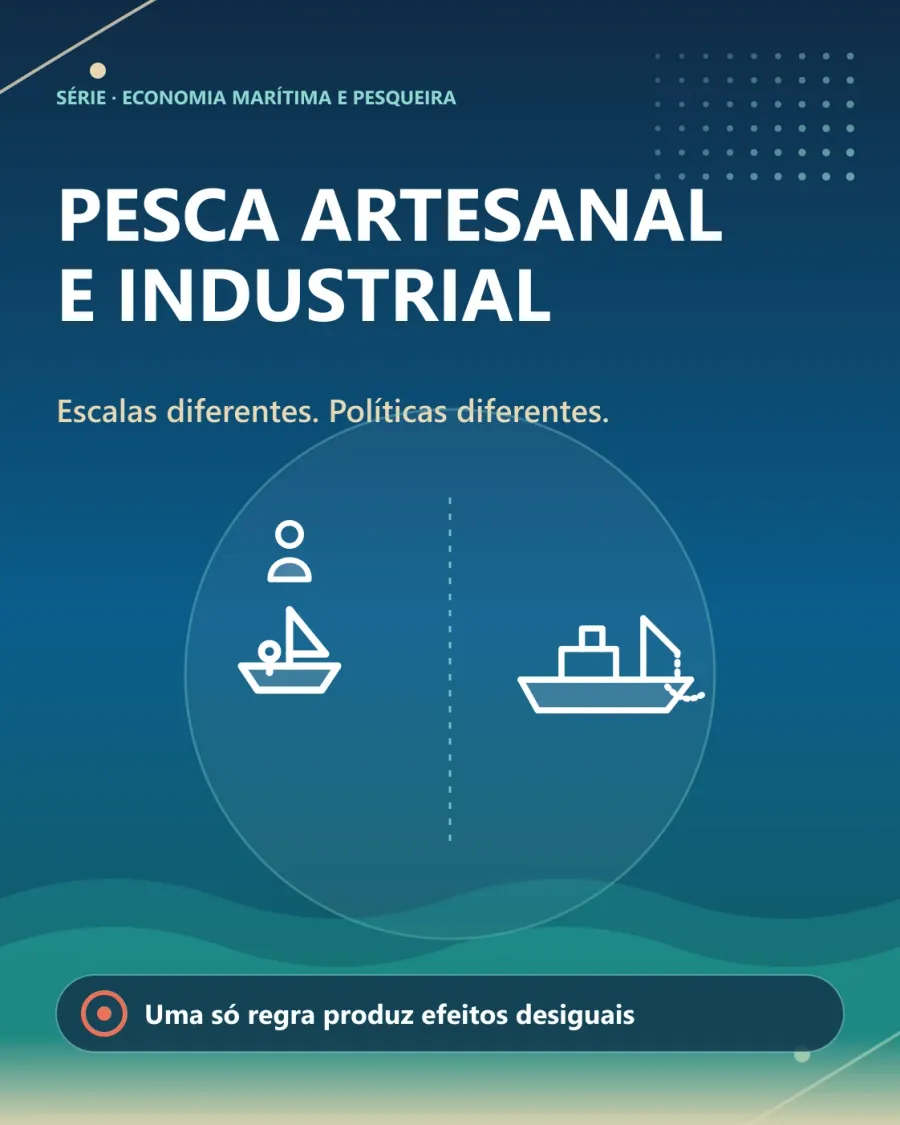
Small-scale fishing is more tied to the territory, uses smaller boats and weighs on local income and food security; industrial fishing operates at larger scale, with more capital, technology and logistics. Differences in scale, cost and impact call for specific policies: a single rule produces unequal effects.
Educational and informational content. It is not legal advice, guidance for a specific case or an institutional position. Examples and analyses use only legitimate sources and public data, aggregated or properly anonymised.
Small-scale (artisanal) fishing and industrial fishing have distinct economic structures. The former usually shows greater dependence on the territory, the use of smaller boats, family or community organisation and a significant role in local income and food security. The latter operates at larger scale, with more capital, technology, storage capacity and extensive logistics chains.
Brazilian law recognises this difference. Law 11,959/2009 characterises artisanal fishing as that carried out directly by a professional fisher, autonomously or within a family economy, with their own means or through partnership and, as a rule, on small boats. Industrial fishing involves individuals or companies, hired workers and vessels suited to larger-scale operations.
The General Fisheries Registry (RGP) works as a requirement for access to policies and rights associated with the sector, among them the closed-season insurance benefit and lines of credit. The quality of the registry affects the state’s capacity to identify beneficiaries, track effort and plan measures adjusted to the reality of each group.
Small-scale fishing accounts for a large share of landings in Brazil’s Northeast and sustains many jobs, but it remains less covered by statistics. This gap makes it hard to estimate income, productivity and territorial dependence. Applying a single rule to agents with different scales, costs and technologies can distribute both the benefits and the burdens of regulation unevenly.
For that reason, fisheries policy has to recognise the differences between small-scale and industrial fishing. Regulation will therefore be more effective when it combines common environmental criteria with instruments proportionate to the productive scale, economic capacity and social importance of each segment.
Further reading
- FAO (2015). Voluntary Guidelines for Securing Sustainable Small-Scale Fisheries in the Context of Food Security and Poverty Eradication. Rome: FAO. Guidelines
- FAO; Duke University; WorldFish (2023). Illuminating Hidden Harvests: The Contributions of Small-Scale Fisheries to Sustainable Development. Rome: FAO. doi:10.4060/cc4576en
- Béné, C. et al. (2016). “Contribution of Fisheries and Aquaculture to Food Security and Poverty Reduction: Assessing the Current Evidence”. World Development, 79, 177–196. doi:10.1016/j.worlddev.2015.11.007
- Diegues, A. C. (1983). Pescadores, camponeses e trabalhadores do mar. São Paulo: Ática. — The Brazilian classic on small-scale fishing as a way of life.
- Law 11,959/2009: full text. Law 10,779/2003 (closed-season insurance): full text.
Websites to explore
- Brazilian Ministry of Fisheries and Aquaculture: RGP, closed-season insurance, policies for small-scale fishing.
- FAO — Small-scale fisheries: guidelines and materials on small-scale fisheries.
- Too Big To Ignore — global research network on small-scale fisheries.