Fish stocks are the classic example of a common-pool resource: access is hard to prevent, but the fish caught by one are no longer available to the others. Without rules, every fisher has an incentive to increase effort, and the result can be overfishing and lost income.
Educational and informational content. It is not legal advice, guidance for a specific case or an institutional position. Examples and analyses use only legitimate sources and public data, aggregated or properly anonymised.
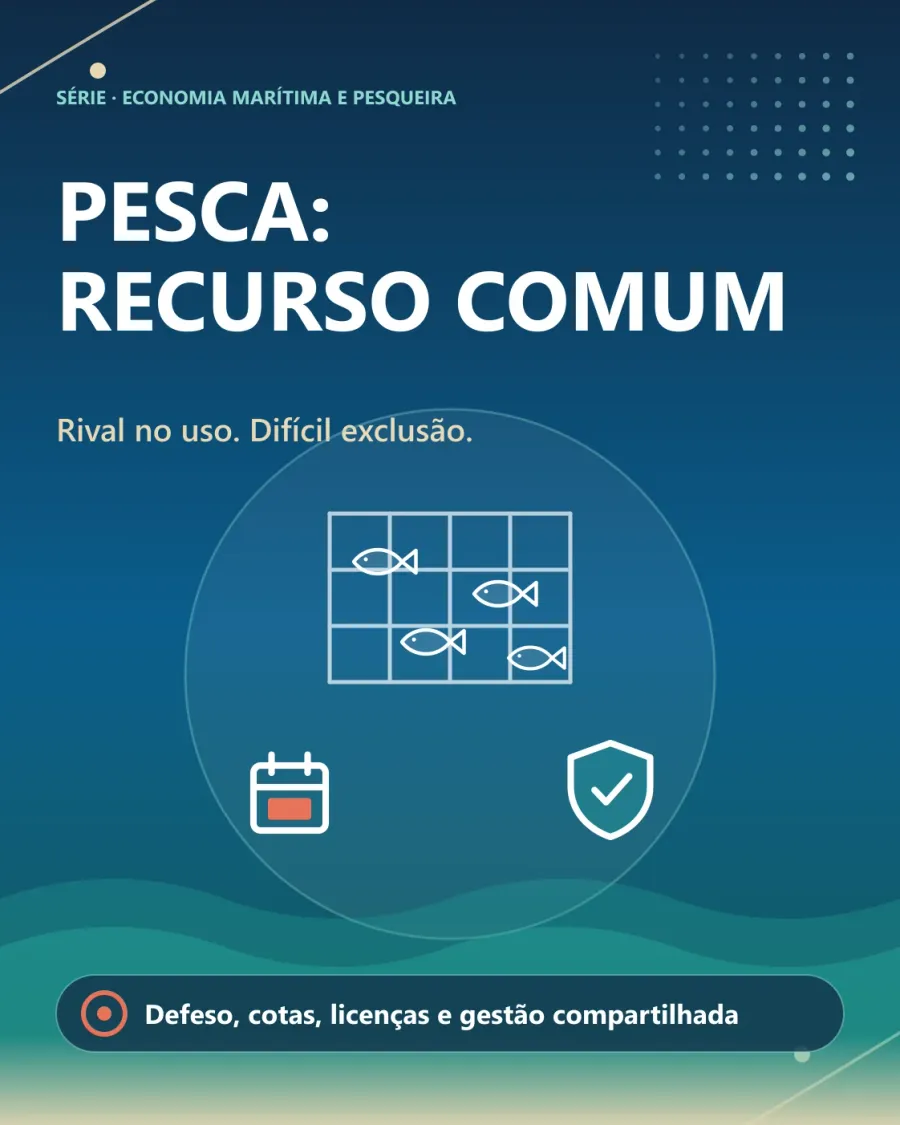
Fish stocks are classic examples of common-pool resources. Excluding users can be difficult or costly, while the fish caught by one agent are no longer available to the others. This combination creates an interdependence that does not appear with the same intensity in conventional private goods.
Without adequate rules, each fisher has an incentive to increase effort before others capture the resource. The behaviour can be rational at the individual level and produce, taken together, overfishing, shrinking stocks and lost income in the long run. Gordon showed that, under open access, effort tends to advance until it dissipates the economic rent provided by the resource.
Hardin popularised this problem as the “tragedy of the commons”, but later literature demonstrated that the outcome is not inevitable. Elinor Ostrom documented situations in which communities manage common resources through clear boundaries, rules adapted to the context, monitoring, user participation and graduated sanctions. Governance can therefore emerge from combinations of state, community and local organisations.
In fisheries, closed seasons, quotas, licences, protected areas, enforcement, monitoring and co-management seek to align effort with the renewal capacity of stocks. In Brazil, the closed season (defeso) combines a temporary ban on catching certain species with income protection for eligible small-scale fishers. Assessing its effects on stocks and income remains a relevant empirical question.
In sum, sustainable fishing depends on institutions that turn the interdependence between users into legitimate and verifiable rules. The challenge is not only to limit catches, but to build a governance that preserves stocks and distributes the costs of conservation fairly.
Further reading
- Gordon, H. S. (1954). “The Economic Theory of a Common-Property Resource: The Fishery”. Journal of Political Economy, 62(2), 124–142. doi:10.1086/257497
- Hardin, G. (1968). “The Tragedy of the Commons”. Science, 162(3859), 1243–1248. doi:10.1126/science.162.3859.1243
- Ostrom, E. (1990). Governing the Commons: The Evolution of Institutions for Collective Action. Cambridge: Cambridge University Press. doi:10.1017/CBO9780511807763
- Costello, C.; Gaines, S. D.; Lynham, J. (2008). “Can Catch Shares Prevent Fisheries Collapse?” Science, 321(5896), 1678–1681. doi:10.1126/science.1159478
- Hilborn, R. et al. (2020). “Effective fisheries management instrumental in improving fish stock status”. Proceedings of the National Academy of Sciences, 117(4), 2218–2224. doi:10.1073/pnas.1909726116
- The 2009 Sveriges Riksbank Prize in Economic Sciences in Memory of Alfred Nobel (Elinor Ostrom): official summary.
Websites to explore
- Brazilian Ministry of Fisheries and Aquaculture — closed seasons: calendar and rules by species and region.
- IBAMA: environmental enforcement and fisheries regulations.
- ICMBio: marine protected areas and management agreements with communities.
- FAO — Code of Conduct for Responsible Fisheries: the international framework for responsible fisheries management.