Fisheries management depends on reliable information about stocks, catches, effort, location, the ocean, climate, prices and communities. Information systems can integrate landings, vessel tracking, remote sensing and local data, provided they are combined with governance, data protection and fishers' participation.
Fisheries management depends on reliable information about stocks, catches, effort, location, oceanographic conditions, climate, prices and the socio-economic characteristics of communities. When these data are fragmented, discontinuous or inaccessible, it becomes hard to set rules, enforce them and evaluate their results.
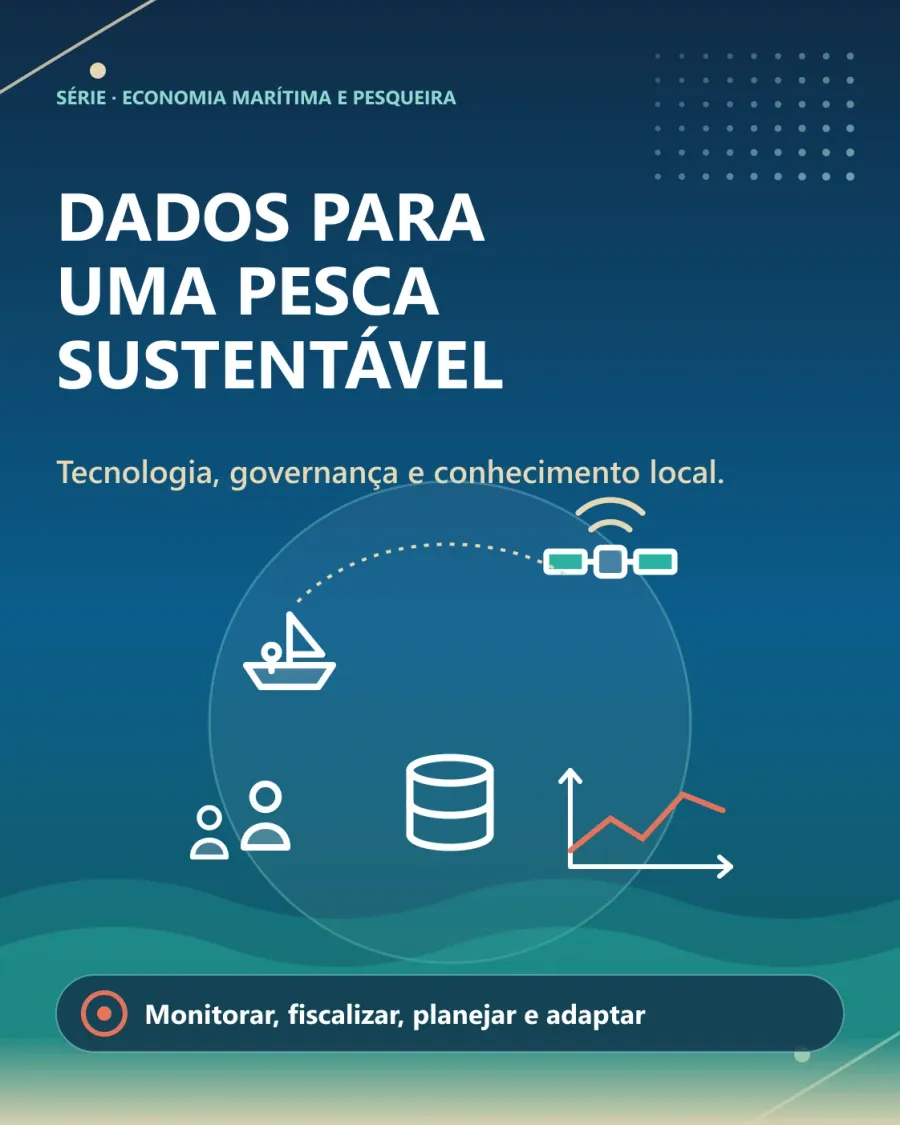
Information systems can integrate landing records, vessel tracking, remote sensing, sea-surface temperature, climate events, protected areas, port infrastructure, municipal data and information provided by communities. This integration supports environmental monitoring, planning, research, enforcement and adaptation to climate change.
Signals from AIS and VMS systems make it possible to reconstruct part of the fishing effort of tracked fleets. In Brazil, the National Programme for Satellite Tracking of Fishing Vessels covers part of the industrial fleet. Satellites also record sea-surface temperature and make it possible to identify marine heatwaves, relating environmental changes to the movement of fish and of fishing effort.
The main blind spot remains small-scale fishing. Many small boats have no tracking, and landing statistics are discontinuous. Local monitoring programmes and apps built together with communities can narrow this gap, provided that fishers’ data are protected, that the purposes of use are clear and that the information produced returns as benefits to the participants themselves.
In short, technology alone does not ensure sustainable fishing. Data need to be reliable, integrated and turned into legitimate decisions through governance, data protection and fishers’ participation. Only that combination allows information to become conservation, income and the capacity to adapt.
Further reading
- Kroodsma, D. A. et al. (2018). “Tracking the global footprint of fisheries”. Science, 359(6378), 904–908. doi:10.1126/science.aao5646
- Hobday, A. J. et al. (2016). “A hierarchical approach to defining marine heatwaves”. Progress in Oceanography, 141, 227–238. doi:10.1016/j.pocean.2015.12.014
- Free, C. M. et al. (2019). “Impacts of historical warming on marine fisheries production”. Science, 363(6430), 979–983. doi:10.1126/science.aau1758
- Ostrom, E. (1990). Governing the Commons. Cambridge: Cambridge University Press. doi:10.1017/CBO9780511807763 — Without governance, data do not become management.
- Brazilian General Data Protection Law — LGPD (Law 13,709/2018): full text — Data on fishers and vessels are personal data.
Websites to explore
- Global Fishing Watch: open map of global fishing effort reconstructed from AIS signals.
- Copernicus Marine Service: open oceanographic data (temperature, currents, chlorophyll).
- NOAA — Optimum Interpolation SST (OISST): the daily sea-surface temperature series used to detect marine heatwaves.
- NOAA Coral Reef Watch: thermal stress alerts for reefs.
- Brazilian Ministry of Fisheries and Aquaculture: PREPS, RGP and fisheries statistics.