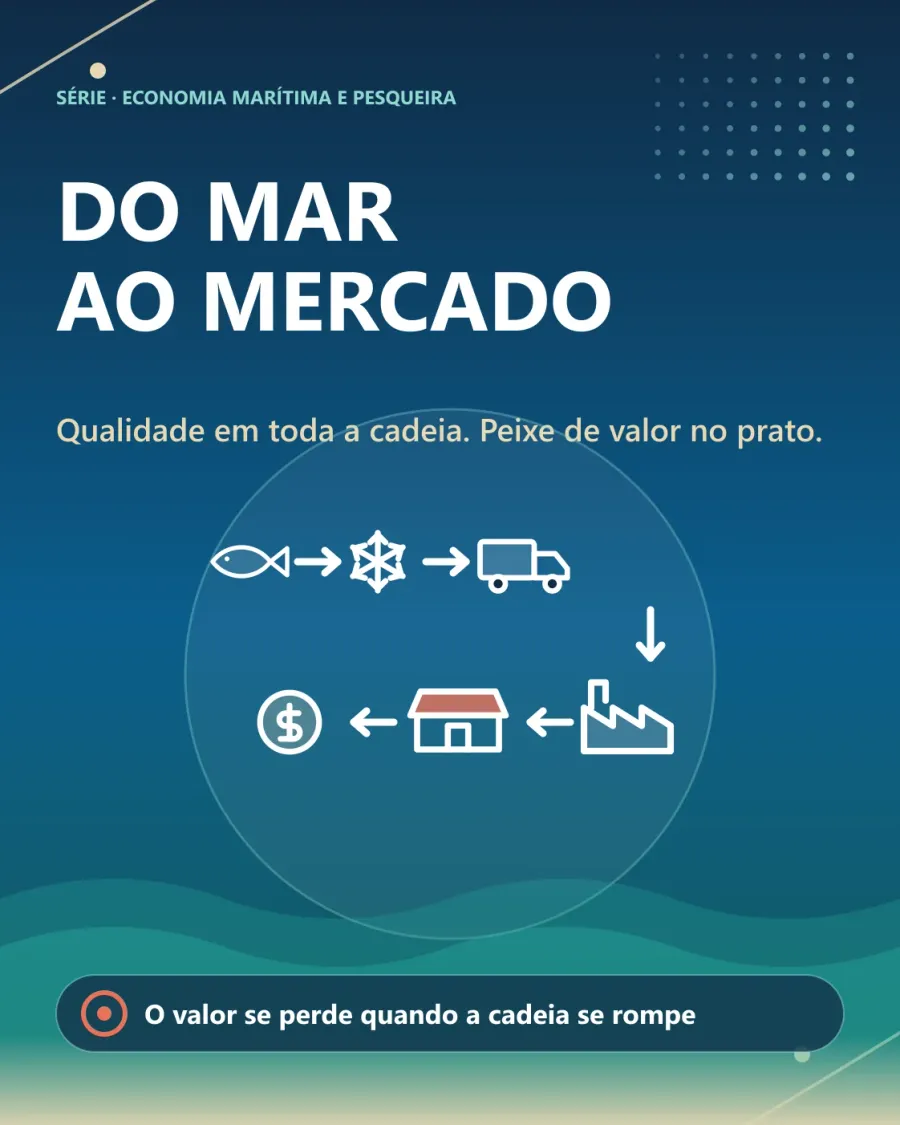
The seafood value chain does not end at the catch. Value depends on integrating capture, landing, refrigeration, transport, processing, marketing and consumption, and breaks in the cold chain cause waste, loss of quality, lower prices for fishers and food-safety risks.
The seafood production chain does not end with the catch. The value of the product is built through landing, refrigeration, transport, processing, marketing and consumption. A failure at any of these stages can reduce quality, interrupt access to markets and lower the price received by the fisher.
Fish is among the most perishable foods. Without adequate ice from the boat onwards, its quality can fall within a few hours. Part of the product may be discarded, while another part reaches the market in poorer condition and sells for less. Both forms of loss undermine income and food security.
These problems hit small-scale fishing hardest, since it often has limited access to ice plants, cold rooms, refrigerated transport and processing units. Investment in these structures can reduce physical and economic losses, but it has to be organised according to the volume, the location and the real conditions of use by communities.
Traceability, sanitary inspection and certification build trust and can open markets that pay better for the product. Meeting these requirements demands records, infrastructure and coordination. Fishers’ guilds, cooperatives and associations can spread costs and ease access for small producers, provided that the organisational mechanisms preserve their autonomy and participation.
In this way, the economic value of fish depends on the continuity and quality of the whole chain. Improving preservation, logistics, collective organisation and information reduces waste, protects the consumer and increases the share of value that stays with those who work in the activity.
Further reading
- Kruijssen, F.; Tedesco, I.; Ward, A.; Pincus, L.; Love, D.; Thorne-Lyman, A. L. (2020). “Loss and waste in fish value chains: A review of the evidence from low and middle-income countries”. Global Food Security, 26, 100434. doi:10.1016/j.gfs.2020.100434
- FAO (2011). Global Food Losses and Food Waste — Extent, Causes and Prevention. Rome: FAO. Full text
- Bjorndal, T.; Child, A.; Lem, A. (eds.) (2014). Value Chain Dynamics and the Small-Scale Sector: Policy Recommendations for Small-Scale Fisheries and Aquaculture Trade. FAO Fisheries and Aquaculture Technical Paper 581. Rome: FAO.
- FAO (2024). The State of World Fisheries and Aquaculture 2024. Rome: FAO. doi:10.4060/cd0683en — Chapters on utilisation, trade and fish losses.
- Brazilian Decree 9,013/2017 (Regulation on Industrial and Sanitary Inspection of Products of Animal Origin — RIISPOA): full text.
Websites to explore
- FAO — GLOBEFISH: market information, prices and seafood trade.
- Brazilian Ministry of Agriculture — inspection of products of animal origin: SIF rules and sanitary inspection of seafood.
- Embrapa Fisheries and Aquaculture: applied research on processing, quality and value chains.